


Best Engineering Branches in 2026 Job Market – High-Demand Career Paths for the Future!

Choosing the right engineering branch has become more important than ever in 2026. With rapid technological advancements, automation, artificial intelligence, sustainability initiatives, and digital transformation reshaping industries, the job market is evolving at a fast pace. Students entering engineering today must align their interests not only with passion but also with future employability, salary growth, global demand, and industry relevance.
In this comprehensive guide, we explore the best engineering branches in the 2026 job market, based on demand trends, innovation growth, salary prospects, and long-term career sustainability.
1. Computer Science Engineering (CSE)
Computer Science Engineering continues to dominate the job market in 2026. With digitalization penetrating every industry — healthcare, banking, education, manufacturing, and retail — CSE graduates are among the most sought-after professionals globally.
Why CSE is in High Demand:
-
Artificial Intelligence and Machine Learning expansion
-
Cloud computing and DevOps growth
-
Cybersecurity threats increasing globally
-
Software development across industries
-
Data science and analytics boom
Top recruiters include global tech giants like Google, Microsoft, Amazon, and Infosys.
Career Roles:
-
Software Developer
-
Data Scientist
-
AI Engineer
-
Cybersecurity Analyst
-
Cloud Architect
Salary Outlook:
Entry-level salaries are among the highest in engineering, with significant growth potential in AI and data science roles.
2. Artificial Intelligence & Machine Learning (AI/ML)
AI and Machine Learning have emerged as specialized branches of engineering and are reshaping industries in 2026. Automation, predictive analytics, robotics, and generative AI tools are transforming the global workforce.
Why AI/ML is Booming:
-
AI adoption in finance, healthcare, and logistics
-
Self-driving technologies
-
Smart automation systems
-
AI-driven business analytics
Companies such as OpenAI, NVIDIA, and Tesla are heavily investing in AI talent.
Career Roles:
-
Machine Learning Engineer
-
Robotics Engineer
-
AI Research Scientist
-
NLP Engineer
This branch offers strong international opportunities and research-oriented careers.
3. Electronics and Communication Engineering (ECE)
Electronics and Communication Engineering remains one of the most versatile branches in 2026. With the rollout of 5G, IoT expansion, semiconductor manufacturing growth, and satellite communication systems, ECE graduates are in high demand.
Key Growth Areas:
-
Semiconductor industry expansion
-
Embedded systems
-
Telecommunications
-
Consumer electronics
-
Space communication
Leading employers include Qualcomm, Intel, ISRO, and Samsung.
Career Roles:
-
Embedded Systems Engineer
-
VLSI Design Engineer
-
Communication Systems Engineer
-
Network Engineer
ECE offers both core electronics jobs and IT-sector flexibility.
4. Electrical and Electronics Engineering (EEE)
With the global focus shifting toward renewable energy, electric vehicles, and smart grids, Electrical and Electronics Engineering is gaining renewed importance in 2026.
Why EEE is Future-Proof:
-
Growth of solar and wind energy projects
-
EV charging infrastructure expansion
-
Smart city development
-
Power automation systems
Companies like Tesla, Siemens, and ABB are major recruiters.
Career Roles:
-
Power Systems Engineer
-
Renewable Energy Engineer
-
Electrical Design Engineer
-
Automation Engineer
As sustainability becomes central to global policies, EEE graduates will see increasing opportunities.
5. Mechanical Engineering
Mechanical Engineering remains a backbone branch of engineering. Although traditional manufacturing roles have evolved, new-age mechanical engineers now work in robotics, automation, aerospace, and electric mobility.
Emerging Fields:
-
Electric vehicle design
-
Robotics and automation
-
Aerospace engineering
-
3D printing and advanced manufacturing
Major employers include Boeing, Tata Motors, and Mahindra & Mahindra.
Career Roles:
-
Automotive Engineer
-
Robotics Engineer
-
Design Engineer
-
Production Engineer
Mechanical Engineering remains highly relevant for students interested in core engineering sectors.
6. Civil Engineering
With rapid urbanization and infrastructure development across India and globally, Civil Engineering remains essential in 2026.
Growth Areas:
-
Smart cities
-
Sustainable infrastructure
-
Green building technologies
-
Urban planning
Infrastructure giants like Larsen & Toubro and Shapoorji Pallonji Group are key recruiters.
Career Roles:
-
Structural Engineer
-
Construction Manager
-
Environmental Engineer
-
Transportation Engineer
Civil Engineering offers stable career prospects, especially in government and infrastructure projects.
7. Biotechnology Engineering
Healthcare innovation, pharmaceuticals, and genetic research have significantly boosted Biotechnology Engineering in 2026.
Key Demand Drivers:
-
Vaccine research
-
Genetic engineering
-
Bioinformatics
-
Pharmaceutical development
Top organizations include Serum Institute of India and Biocon.
Career Roles:
-
Research Scientist
-
Clinical Research Associate
-
Bioinformatics Specialist
-
Pharmaceutical Engineer
Biotechnology is ideal for students interested in life sciences and research careers.
8. Data Science & Information Technology
Although often part of Computer Science, Data Science and IT have become standalone high-demand branches.
Why This Field is Expanding:
-
Big data analytics
-
Business intelligence
-
Digital transformation projects
-
E-commerce expansion
Organizations such as Accenture and Deloitte actively hire data professionals.
Career Roles:
-
Data Analyst
-
Business Intelligence Engineer
-
IT Consultant
-
Systems Architect
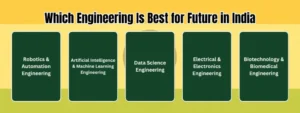
How to Choose the Right Engineering Branch in 2026
While job demand is important, students should also consider:
-
Personal interest and aptitude
-
Long-term industry growth
-
Internship opportunities
-
Higher education options
-
Global demand trends
For example, students inclined toward coding and analytics may prefer CSE or AI/ML, while those interested in infrastructure may choose Civil Engineering.
Future Engineering Trends in 2026
The engineering landscape is shaped by:
-
Artificial Intelligence integration across sectors
-
Renewable energy expansion
-
Automation replacing repetitive jobs
-
Smart cities and digital infrastructure
-
Cybersecurity emphasis
-
Climate change and sustainability focus
Branches that align with these trends will continue to grow over the next decade.
Conclusion
In the 2026 job market, engineering remains one of the most promising career paths. However, the most successful engineers will be those who combine technical expertise with adaptability, continuous learning, and practical experience.
Computer Science, AI/ML, Electronics, Electrical, Mechanical, Civil, Biotechnology, and Data Science are among the top-performing branches in terms of job demand and salary growth. Each branch offers unique opportunities, and the right choice depends on both passion and market relevance.
The future belongs to engineers who innovate, solve real-world problems, and adapt to technological change. Choose wisely, prepare strategically, and focus on skill development alongside academic excellence.